
I told you I built the whole year around strength...
Then I checked my own data....

AI + Garmin
I never thought about doing this, but since I’m working on launching my paid tier here on Substack and the more I did research on social proof related to my coaching business, the more I saw the need to pull my Garmin history, starting from 2024, run it through Claude and see what it came back with.
Granted, I had to do a lot of back and forth since many things didn’t make any sense initially…turns out those LLM’s are not as smart as you’d think…but I found some numbers that did give me a completely different perspective.
I will always admit when I’m wrong, especially when numbers show a different thing, just so you know…so a month ago, in the Muskoka race report, I wrote this:
“I stopped treating strength work as a February thing I squeeze in before triathlon season starts, and built the whole year around it instead.”

The Social proof…
But…let me just give you couple of findings…so, here’s what the 2025 race build actually looked like for my most challenging race so far: Ironman Ottawa 2025.
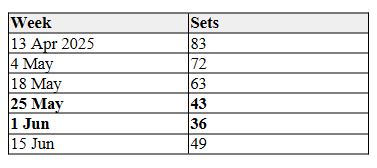
Eighty-three sets a week down to thirty-six. A 57% decrease, getting there exactly as my endurance volume climbed toward fifty hours a month.
So, yeah, let’s have it…I did the thing I told you I’d stopped doing…but, this is what I felt at the moment, like what was happening…
Big reality check
It wasn’t laziness and it wasn’t a conscious decision, it all happens deep down in your brain since I never sat down in May and chose to cut my lifting in half. But, definitely, the peak arrives, the crazy long rides eats Saturday, Monday the legs are a mess, and the session that moves is never the ride of course! You need to be on that bike man! Six weeks later it’s already happened and I noticed nothing!!
I’m doing deep research now from Reddit, X, youtube, etc…and found this from r/Ultramarathon: “I always lost a lot of strength as the running, biking and swimming increased in volume. What I wonder now is if that’s expected or if I actually can balance all three goals.” The replies contradicted each other.
When you really think about it, you would think, “you see…muscle is gone, strength, so why bother bla bla”… but, I got away with it!! Didn’t I? I finished an Ironman…following April I did my PB on a Marathon…

Looking at the numbers again…
But, if you see my number again, that’s thirty-six sets a week across every muscle group, which works out to around five or six sets per muscle. I’ve learned this recently from my nerdy and sciency PT certification: The maintenance sits at one to four, so there you go…I never came close to it!
But I didn’t know that at the time. If I’d been watching those numbers that spring I’d have spent the build being anxious and overthinking about a problem I did not have.
The reason it worked isn’t discipline, the reason is the floor is far lower than anyone tells you. I think that’s always the question, how much should I do??
Spiering and colleagues reviewed exactly this question in 2021: what is the least you can do and still hold what you built. In younger populations, strength and muscle size held for up to thirty-two weeks on as little as one session a week and one set per exercise. Older populations need more, up to two sessions and two to three sets per exercise, and that gap deserves its own post.
Either way, the number is nowhere near eighty-three, which was what I was doing in April, before I hopped on a bike here in Toronto.
What to make of all this…
Now the big thing to understand and key takeaway from this post, and it’s the one everyone tries to come up with all the time and that is: Volume can fall off a cliff. Frequency can fall off a cliff. Load cannot.
Their stated primary conclusion is that exercise intensity seems to be the key variable for maintaining performance over time, despite relatively large reductions in frequency and volume.
So what actually costs endurance athletes their strength is not the missed session. It’s the varying, the drifting, going sideways. The weight comes down, the sessions quietly turn into circuits, and that’s where it goes…not in the gap. In going with light weight!
I have to be precise about light, because getting this wrong in the other direction is worse than going sideways. Light means easy relative to what you can currently do. It does not mean “not heavy.”
A set of twenty taken close to failure is a maintained load. The same twenty with a weight you could have doubled is not. You’re protecting the demand, not the number on the bar.
What happens as we get older…
This matters more the older you are, and it runs opposite to what most people assume. In a meta-analysis of older adults, a higher training intensity as a percentage of 1RM was associated with a smaller increase in type II fibre size, not a larger one (Straight et al. 2020). So the instruction is never “lift heavier.” It’s keep it hard. Those are two different sentences and only one of them is right.
I got through a full race season on 57% less lifting and it cost me nothing, and I couldn’t have told you why until last Friday, when I spent all afternoon going through all this data. Next season I’d rather know going in than find out in a spreadsheet afterward.
Friday I’m putting the actual floor on a post. How low the volume can go, what load has to survive, and where those sessions sit in a week that already has ten hours of endurance in it. FYI, this will be my first ever paid post, it’s the first one for members. Strength First Athlete is taking it to the next level!
If you are ready to stop figuring it out alone, to own your progress with a real program and a coach who adjusts it based on your feedback, APPLY FOR COACHING or reply to this email.
Sources
1. Spiering BA, Mujika I, Sharp MA, Foulis SA (2021). Maintaining Physical Performance: The Minimal Dose of Exercise Needed to Preserve Endurance and Strength Over Time. Journal of Strength and Conditioning Research 35(5):1449-1458. https://doi.org/10.1519/JSC.0000000000003964
2. Straight CR, Fedewa MV, Toth MJ, Miller MS (2020). Improvements in skeletal muscle fiber size with resistance training are age-dependent in older adults: a systematic review and meta-analysis. Journal of Applied Physiology 129(2):392-403. https://doi.org/10.1152/japplphysiol.00170.2020
Very insightful article, Abel. Thanks for sharing.