
Kilometer 26, Score Settled!!

Does strength training help marathon performance?
Yes. Strength training builds the structural support, quads, glutes, posterior chain, single-leg stabilizers, that absorbs the load running puts on your joints. Without it, the interference effect plays out: high running volume without strength leaves muscle fibres shrinking and the joints picking up the bill. Four lower-body sessions a week, alternated between runs strategically, is what turned a 2022 marathon DNF into a sub-3:50 PR four years later.
No Phone Call This Time
I hit kilometer 26 on Sunday and I knew exactly where I was…same race, similar course (they made some changes)…same stretch where, in April 2022, I called my wife to go and pick my up from the nearest GO train station with a knee that had given out, a stomach full of norovirus, and shivers I could not stop. I keep saying it…the brain is an interesting machine for sure…I remembered the rain that day, the wind, remembered the 20 minutes it took to walk to that station, the longest 20 minutes of any race I have ever attempted. How much I wanted to cry…
This time it was a sunny, almost no wind, strong legs, stomach holding (we’ll get to this!!). I was on pace to achieve my set goal, and I was moving through that exact stretch instead of stopping at it. Also, just to put a little more pressure on me, I left my flip phone at home so that I was not calling anyone today…and I kept running.
The clock at the finish read 3:49:35. Sub-3:50 by 25 seconds. A personal record. Four years later, but on the same course where the score had been left open.

The story tried to repeat itself…
Now, this is the interesting part, funny seeing it now, since I finished, otherwise…but, here is the part I did not see coming.
Five days before the race, I got hit with a stomach bug. Not “feeling off” stomach bug like 4 years ago, but the kind that put me in bed for two days straight , eating little snacks and throwing them up afterwards…(this time I’m giving you the picture…). I couldn’t believe…seriously…same week, same race, same ridiculous twist of timing as 2022, except this crazy version of the virus came in early enough that I had 5 days to take care of myself and climb back.
The uncertainty was real on Sunday morning…could my stomach handle the gels? Would the fueling I had spent four months dialing in stay where I put it? Honestly, I did not know. I drank what I could on Saturday as far as electrolytes, then Sunday I woke up early, had my breakfast, coffee, took the Uber to the event and started anyway. The plan was: trust the prep, take the fuel on schedule, and adjust if my body started giving warning signs. Happy to say…none came!!
That is not luck. That is what happens when nutrition becomes a training variable instead of an afterthought, and when you have practised the exact fueling pattern enough times that your gut knows what to do with it.
Why this body finished what the 2022 body could not
The body that ran through kilometer 26 on Sunday was not the body that walked off the course in 2022. The difference is not mysterious, and I want to write it out clearly because it is the entire point of this Substack and the philosophy behind the coaching…
In 2022, my prep was running, more running, almost no lifting, almost no posterior chain work, almost no single-leg loading. I genuinely thought marathon preparation meant adding kilometers. The knee that gave out at kilometer 26 was a knee that had been asked to absorb everything the surrounding muscles were not built to take…again, that was not bad luck.
Four years later, the prep was different by design. Four strength sessions a week, lower-body focus, compound movements as the anchor. Squats, deadlift variations, lunges, a lot of single-leg work. The muscles that were essentially absent from my 2022 build.
Nutrition got the same treatment. 40 grams of carbohydrate per hour once an effort goes past 90 minutes for a key session. Protein spread across the day instead of dumped into one post-workout window, which means a runner doing 28-plus weekly kilometers and lifting on top is not allowed to skip meals casually. Recovery as a non-negotiable, sleep treated as training. None of this is fancy, but again, it all adds up and makes a big difference.
I want to reiterate, this is what the philosophy of this Substack actually looks like in practice. Strength is not a complement to endurance. It is the structural foundation that lets the endurance show up on race day instead of breaking down in the rain at kilometer 26.
The race
Sunday turned out to be a perfect race in every sense…the pacing held, I stayed in the heart-rate band I had built across 42 runs and 50 strength sessions over the past few months, the gels and hydration went down on schedule, the legs stayed under me through 30, 32, 35, 38, not so much in the 40thK mark...legs were toast by then, but is not supposed to be comfortable, marathons never are at that point, but they were not a breakdown.
A close friend of mine showed up to pace me through the final 10 Kilometer. He said the right things at the right time. My wife, the same one who picked me up from a GO train station four years ago, this time waiting at the finish with my girls.
The medal is around the neck. The official time, 3 hours 49 minutes 35 seconds. The PR is real, but the sentence I keep coming back to is simpler than any of that…
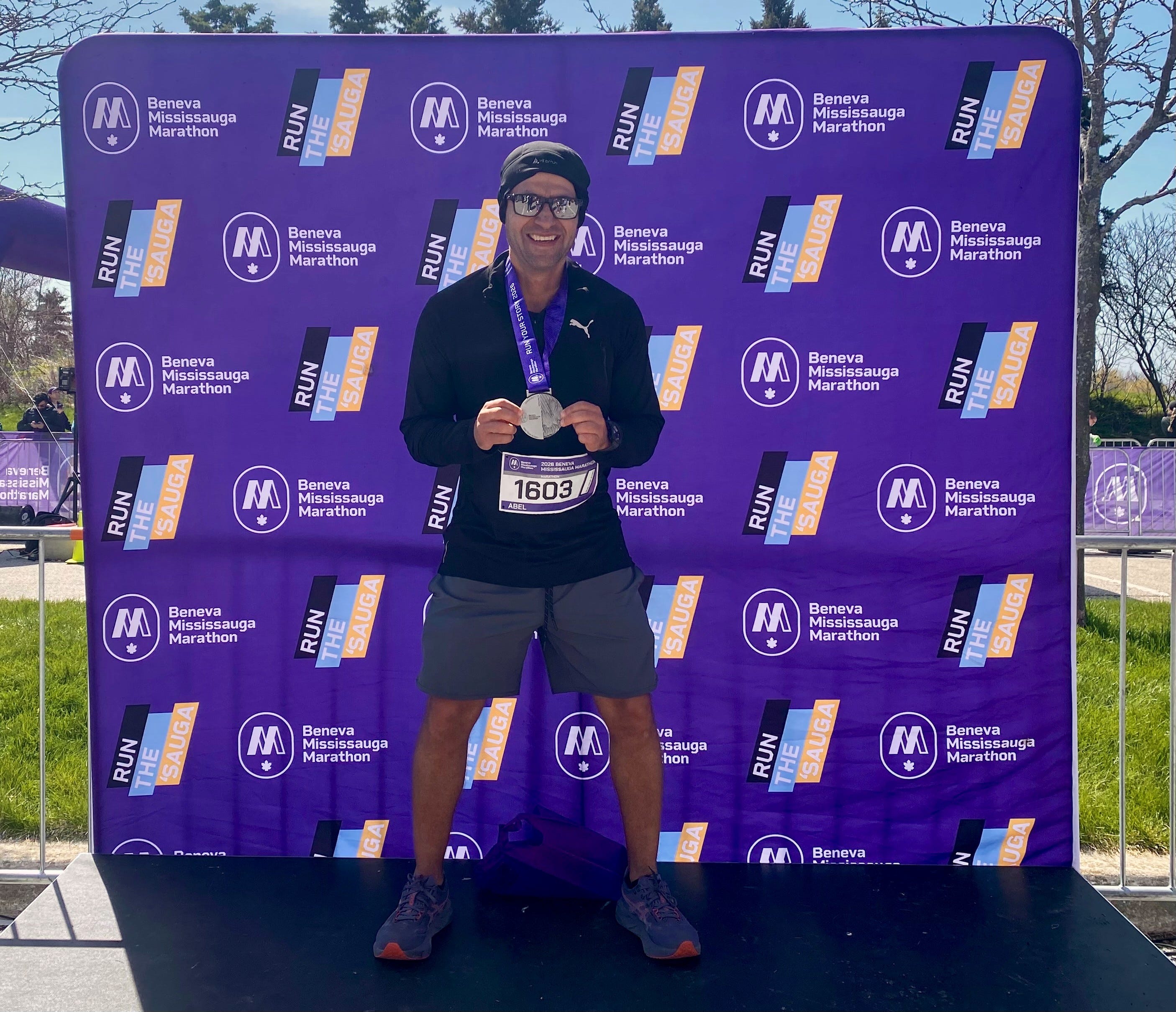
The race prep does not start at the start line. It starts in the gym, months earlier, when nobody is watching and there is no medal on the line. (Ask me how I know.)
Subscribe to Strength First Athlete if you want weekly training pieces built around one idea: strength comes first, distance follows.
Training for a sprint tri, Olympic, or full marathon and want a program built specifically around your race, your body, and your schedule? Reply to this email. That is what I do.
This is awesome man thanks for sharing. So much bigger than just a race. Proud of you for this accomplishment brother!
Hi Abel, really loved this piece — especially the part about the body you bring to the start line being built months earlier in the gym. That resonates. I’ve run three marathons myself, all after the age of 60, and the difference between the builds where I lifted consistently and the ones where I didn’t was night and day. Strength isn’t optional once you’re past a certain age — it’s the thing that keeps you in the game.
I see the same pattern in pickleball. I’m 78 and still play and coach several days a week, and the players who stay strong — glutes, posterior chain, single‑leg stability — move better, get injured less, and hold up deep into matches. Endurance shows up when the structure underneath it is solid.
Your story about kilometer 26 is exactly what I’ve watched happen on the courts and in my own training: the body that breaks down is not the same body that finishes strong. The prep is the difference.