
Willing gets you to day one. This gets you to day ninety.

Why do I lose motivation to train after a few weeks?
Because willingness is a decision you make once, on a good day, then have to re-make every morning as a tireder, busier version of yourself. Re-arguing the same case daily for months wears you down, and the part of you that wants to skip eventually wins. It’s not weakness. It’s how willpower works. Identity removes the daily argument.
Two weeks ago I told you that you don’t need to be ready, you just need to be willing. Hopefully, that got a lot of you to day one. Now, let’s go over what decides whether you’re still going on day ninety.

Willing was a decision you made once...easy in a sense, a clear-headed version of you, on a good day, you sat down and said yeah, let’s do this! That decision is real. But it was made by the best version of you, and it gets erased, let’s say, by whoever actually shows up tomorrow morning.
Let me just give you real quick some examples of other versions: Tired. Sleep deprived. A kid up at 2am. Rain on the window. In my case here, tons of snow outside during winter...and that person didn’t sign up for anything, and every single morning you’re asking him to honor something he doesn’t remember agreeing to.
Willingness doesn’t survive forty-seven mornings in a row. Reality is, something else has to take over before the arguing wears you down to tiny bits, because the arguing back always wins eventually..no matter what you do!
The ladder almost nobody climbs, a quick recap!
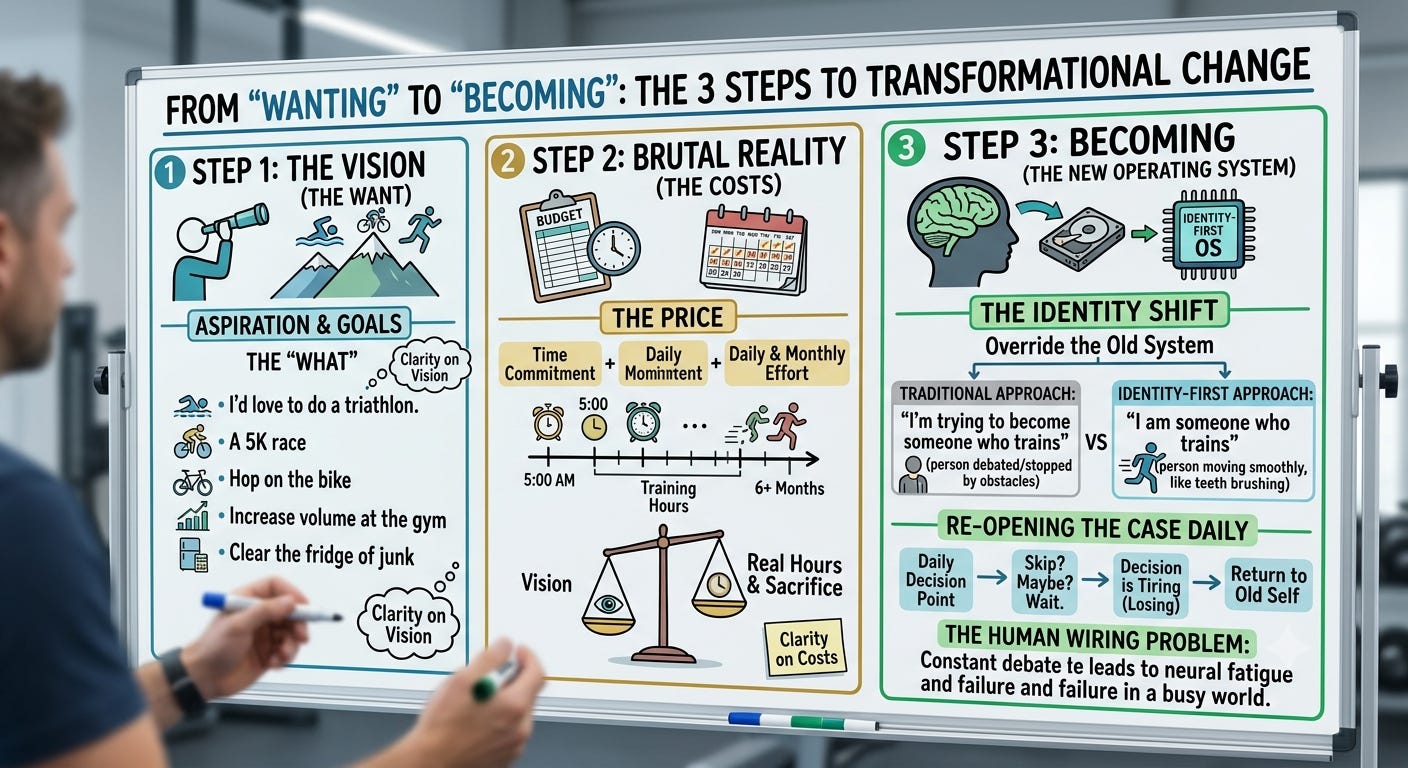
I’ll talk about three steps. First one, the want: I’d love to do a triathlon, a 5K, hop on the bike, increase volume at the gym, clear the fridge of junk, whatever you want to call it. Then the brutal reality check: here’s what it actually costs, the hours, the early alarms, the months. Most people get both, the vision and they have the clarity.
Final and third step, and almost nobody makes it. Becoming, overriding the old operating system. The move from “I’m trying to become someone who trains” to “I am someone who trains.” It sounds like a small wording change. It’s the difference between finishing and quitting, and here’s why.
Someone who already thinks of themselves as a runner doesn’t debate whether to run on a cold Tuesday. There’s nothing to debate. Running is just what they do, like brushing their teeth. Someone who’s “trying to become a runner” re-opens the case every morning. Should I? Is today the day I skip? Maybe I’ll go later. And revisiting the same point every day for months is tiring enough that, eventually, you lose. Not because you’re weak or lazy or broken, it’s how we are wired and in today’s world...again, we are not going to win.
What the science says about the negotiation ending
There’s measurable science under this. A 2010 study by Phillippa Lally and colleagues at University College London tracked 96 people who each picked one new daily behavior, a walk or a piece of fruit with lunch, logged it daily for twelve weeks, and tracked how long each one took to become automatic, the point where doing it stopped requiring a decision.
The median was 66 days. The range ran from 18 days to 254, depending on the person and the habit. Two and a half months, on average, of conscious effort before the thing ran on its own. That’s the stretch nobody warns you about. Willingness has to cover the distance between day one and the day the behavior finally stops asking permission. Identity is what gets you across it, because while you wait for the habit to set, the story you tell about who you are is doing the heavy lifting.
Mont-Tremblant, twice
Maybe you’ve read this post, maybe not, but I learned this on a course that tried to break me two years in a row. 2 different scenarios.

Mont-Tremblant, Quebec. 2023, my third 70.3. We drove up with friends and all the kids, brutal hilly bike leg. Then the Quebec wildfires rolled in. We walked into transition and the bikes were covered in ash, like a volcano had gone off somewhere overnight. I got my wetsuit on, walked down to the lake, and the staff started yelling: cancelled, cancelled. People cried. I was willing that day, completely willing, and the day got taken from me anyway. I took the deferral for 2024 and rode the 10km back to the hotel.
2024, same town, same hotel, same beat-up Specialized Allez. I came back for one reason: I’d started something and I was going to close it. Race morning it was pouring, crazy, wind throwing bikes sideways in the racks. People walked up, looked at the lake, took off the timing chips off their ankles and left. They weren’t being weak, I know that for sure, but they were doing the math, in the rain, that morning, and the math said go home.
I never did that math. I got into water so choppy I could barely breathe, finished a swim they ended up cutting short, rode 90km through puddles and crosswind, and ran my first sub-2-hour half in a 70.3. (My wife picked me up at the finish. She always does.)
The people in that parking lot were negotiating. I’d settled the question months earlier and that’s the only reason I was still moving when it got ugly.
Three small shifts, not affirmations
So how do you make the jump? Not with mirror affirmations, sorry but forget about this. Again, small behaviors that hand your brain evidence.
Watch your language. “I train for triathlons” instead of “I’m trying to train for one.” Small, repeated, it reshapes how you see yourself over weeks.
Lay your gear out the night before. Sleep with them if that’s necessary! That’s proof, not prep. You’re showing yourself, in advance, who tomorrow already belongs to. Work around your environment.
And keep one question in your back pocket for the bad mornings: what would someone who does this do right now? You won’t speak against the part of you that wants the warm bed. So skip the argument and just ask the question and let the answer move your feet.
You don’t train because you’re already a triathlete. You become one, slowly, by acting like it’s true before the proof shows up.
The morning it’s pouring and every reasonable part of you wants to take off the chip and walk back to the car, you’ll find out which version of you signed up. Make sure it was the one who already decided who he is.
Not sure where you actually stand? I put together a free “Transformation Readiness Profile” self-assessment. A handful of straight questions, five minutes, and it’ll tell you more about your starting point than another article will.
[Take the Self-Assessment → Transformation Profile]
Sources
1. Lally, P., van Jaarsveld, C. H. M., Potts, H. W. W., & Wardle, J. (2010). How are habits formed: Modelling habit formation in the real world. European Journal of Social Psychology, 40(6), 998-1009. https://onlinelibrary.wiley.com/doi/abs/10.1002/ejsp.674
This hit. At some point you either keep holding daily meetings with the version of you that wants the easy option, or you make the decision once and let your actions catch up. That's true for training, business, writing... pretty much anything worth doing.
The identity part is the real gold here. The people who last aren't always more motivated. They've just stopped asking themselves for permission every morning.
Great article, brother.
Hi Abel, great article, great infographic...I took the test. You did a great job with it. The whole idea of motivation rarely transforming into success, whether it's getting into shape, no matter what, it's so important. I see it in pickleball training, as you can imagine.
I'm creating a similar type quiz for pickleball players. It's a self-assessment that grades them on different aspects of the game and gives them a score. Mine will also give them instructions on how to improve. I'll be giving the first quiz for free. I suggest they retake the test every 20-30 days and will be charging for retests. I'll let you know when it's done.