
Your wearable is not your coach. Here's what to actually use it for.

Is my smartwatch’s heart rate accurate?
For most people, yes. Optical wrist sensors track resting and steady-state heart rate within a few beats per minute of a chest strap or ECG. The number is reliable for Zone 2 and long aerobic work. Wrist HR drifts during intervals, sprint efforts, and high-intensity training, because the sensor struggles with fast changes and sweat. If you need precision for hard sessions, wear a chest strap. Otherwise, the wrist is close enough to guide you.
The problem with letting a device define how you feel
This is definitely something I see coming up a lot now in the Substack Notes and from many other people on the platform. On top of this, during one of my Personal Trainer modules, related to Energy, metabolism, our teacher showed us evidence as to why all these wearables might not be most reliable thing...yes, it might give you an idea on HR during a run, but to measure calories and sleep...not so much!
Up until recently, I was convinced and fooled about all the calories I burned during a 30km run, but turns out it’s just better for counting steps and nothing else. Speaking of sleep, sometimes when my Garmin says I had a great night sleep, somehow it scores it! How? No clue...Based on what? No clue either! So, it said, “calm and refreshing”, and I felt sooo tired, or also viceversa, I scored 50 and I felt amazing ready to kill any session!
So, basically, your fitness tracker told you that you burned 800 calories on a decent long run, but it was probably off by 35%. So, let’s go through some info and what it’s actually reliable on.
Nowadays there are two kinds of people wearing watches right now. The first one trusts the device completely. Their watch says 900 calories burned, so they eat the cookie, and the second cookie, like me! I’m a cookie monster according to my girls! and then wonder why body comp is not moving. The second one gave up on the data entirely after one weird reading, tossed the watch in a drawer, and now trains on feel alone. Both are leaving something on the table. Wearables are useful, but only for the questions they can actually answer. The rest is a guess dressed up in a nice interface.
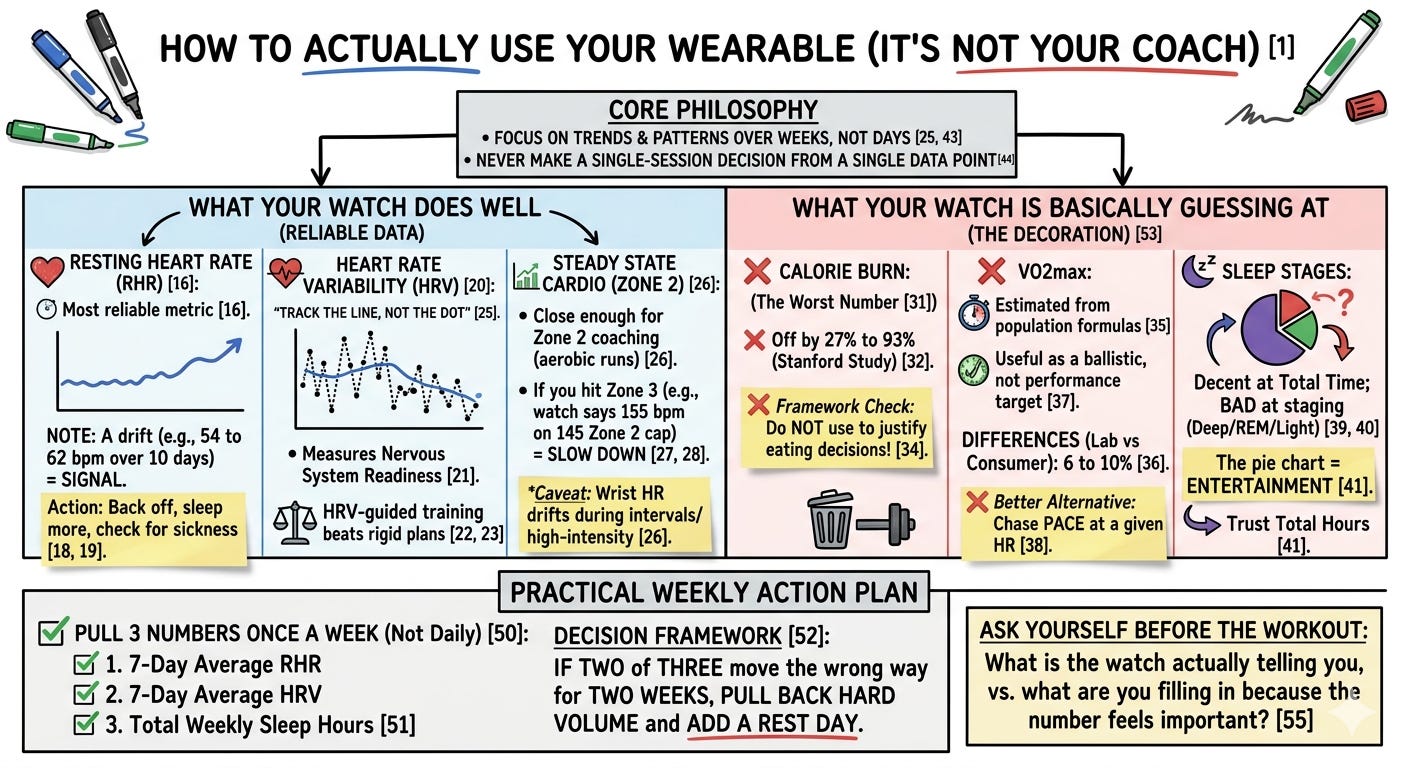
What your watch actually does well
Heart rate at rest, and heart rate over weeks. This is the most reliable number on your wrist. Optical wrist sensors track resting and steady-state heart rate within a few beats per minute of a chest strap or ECG for most people (Shcherbina et al., 2017). If your resting HR has drifted from 54 to 62 over ten days and nothing else in your life has changed, that is signal. Take it seriously. Back off, sleep more, check if you are getting sick.
Heart rate variability, metric that has become sooo popular lately, watch it over weeks, not days. HRV is the time gap between heartbeats, and it reflects how ready your nervous system is to handle hard work. A 2020 meta-analysis of endurance athletes found that HRV-guided training produced better gains in VO2max and performance than rigid pre-planned programs, because athletes trained hard on days their body was ready and backed off when it was not (Granero-Gallegos et al., 2020). A 2023 trial in cyclists found the same pattern over 8 weeks (Figueiredo et al., 2023). The catch is that HRV is noisy day to day. One low reading means almost nothing. A seven-day rolling average trending down means something. Track the line, not the dot.
Heart rate zones during steady cardio. Your watch is reasonably accurate for the wide Zone 2 band most endurance work lives in. Wrist HR drifts during intervals and high-intensity efforts (the sensor struggles with fast changes and sweat), but for a long aerobic run at conversational pace, the number on your wrist is close enough to coach you. If your Zone 2 cap is 145 bpm and your watch says you are at 155, you are going too hard. Slow down, right?
What your watch is basically guessing at
Now the other side.
Calorie burn. The worst number on your watch by a long shot. The Stanford study that tested seven popular wearables found calorie estimates off by 27 to 93 percent across devices, while heart rate on the same wrists was accurate (Shcherbina et al., 2017). Newer watches have not closed that gap much, because the inputs (activity type, body composition, actual effort) are hard to estimate from a wrist. Do not use calorie burn to justify eating decisions. If you want to manage energy balance, track food intake with care and let the scale and body composition confirm over weeks.
VO2max. Consumer watches estimate VO2max from submaximal data, running pace against HR, and population formulas. Recent validation studies in recreational runners found VO2max from consumer watches differed from lab testing by 6 to 10 percent in either direction, with several devices underestimating trained athletes (Caserman et al., 2024; Železnik Mežan et al., 2025). The number is a useful ballpark. It is not a performance metric to chase. Chase pace at a given HR instead. If you are running 4:45/km at 150 bpm this month and 4:40/km at 150 bpm next month, your fitness is improving, no matter what the watch says.
Sleep stages. Wrist devices are decent at total sleep time and bad at staging. A 2023 review comparing consumer trackers against polysomnography found wearables overestimate total sleep by around 10 minutes, doesn’t classify light sleep as deep roughly a third of the time, and struggle badly with REM during fragmented nights (Lee et al., 2023). Trust the total hours. Treat the pie chart of “deep vs REM vs light” as entertainment, not data.
Trends are signal. Single readings are noise.
The rule that keeps you sane is short. Use wearables for patterns over weeks. Never make a single-session decision from a single data point.
A real example. Your HRV drops 20 percent one morning. You had three glasses of wine, you slept five hours, and your toddler crawled into bed at 4 a.m. The number is accurate and useless, because the context is obvious. Skip the watch, drink water, take the easy day you already knew you needed. Now a different scenario. Your HRV has been sliding for six straight mornings. Sleep looks normal. Training has not been heavy. That is the moment to pay attention, because the pattern is telling you something your feel is missing.
So, here’s something practical everybody can do, just pull three numbers once a week, not every morning. Your 7-day average resting HR, your 7-day average HRV, and your total weekly sleep hours. Write them down somewhere, or in an excel sheet. If two of the three are moving the wrong way for two weeks running, pull back hard volume for a week and add a rest day. That is the watch earning its keep. Everything else on the screen, the calorie count, the VO2max score, the deep sleep minutes, is decoration. Useful to look at, dangerous to plan around.
So ask yourself this before your next workout. What is the watch actually telling you, and what are you filling in because the number feels important? The honest answer is usually the one worth training on.
If you are not sure whether your current training load is matching your recovery, that is what Strength First Athlete is here for...and...there is no watch required.
Sources
1. Shcherbina, A. et al. (2017). Accuracy in wrist-worn, sensor-based measurements of heart rate and energy expenditure in a diverse cohort. Journal of Personalized Medicine, 7(2), 3. https://doi.org/10.3390/jpm7020003
2. Granero-Gallegos, A. et al. (2020). Effects of heart-rate-variability-guided training on endurance performance: a systematic review and meta-analysis. International Journal of Environmental Research and Public Health, 17(21), 7999. https://doi.org/10.3390/ijerph17217999
3. Figueiredo, D. H. et al. (2023). Influence of heart rate variability-guided training on performance and VO2max in trained cyclists. Research Quarterly for Exercise and Sport. https://doi.org/10.1080/02701367.2023.2185712
4. Caserman, P. et al. (2024). Accuracy of consumer wearables in estimating VO2max in recreational runners. Sensors, 24(7), 2216. https://doi.org/10.3390/s24072216
5. Železnik Mežan, M. et al. (2025). Validity of smartwatch VO2max estimation across fitness levels. Sports, 13(2), 45. https://doi.org/10.3390/sports13020045
6. Lee, T. et al. (2023). Consumer sleep trackers versus polysomnography: a systematic review. Sleep Medicine Reviews, 68, 101732. https://doi.org/10.1016/j.smrv.2023.101732