
The finish line at Parliament Hill, one year later
An honest reflection...

August 3rd, 2025. I come around the last corner along the Rideau Canal with maybe 400 meters left, and I hear the announcer before I see the finish line, saw my family and friends and after fourteen-plus hours after jumping into the Ottawa River at Britannia Beach, after 3.8 km of swimming, 180 km on closed parkways, 2.75 loops, which I don’t personally like, and a marathon that went bordering the canal and all the way back to Parliament.
First full-distance Ironman ever held in Canada and first one for me too.
I don’t remember much of the hour after...like you black out or something, I remember my legs not working right. I remember someone handing me the medal and the cool shirt and what I remember clearly, a full year later, is everything that came after that hour.
The re-telling of the story…
For a week or two, I couldn’t stop talking about it. Friends, family, my wife, who’s been through this with me twice now and just nods along at this point. Then, like everything else, people moved on. That’s normal. Everyone has their own life to get back to.
What didn’t go away was what was happening in my head. I replayed the swim start a hundred times, wondering if I’d gone out too hot. I redid the nutrition math gel by gel, I kept thinking about all the people with gut issues, throwing up on the run course, a guy that passed out like in the 110km mark on the bike, and some other details with zero meaning that pop up once in a while. But, the real question I’m sure it comes up to many people like it pops up to me is: now what?
There’s a name for it???
Glad I came across the term: The arrival fallacy. The term comes from psychologist Tal Ben-Shahar’s book Happier: the belief that reaching a goal will hand you lasting happiness, when what it actually gives you is a strange, hollow feeling, totally unexpected, out of nowhere! I’d read about this concept years before Ottawa, but knowing the name for it didn’t make me 100% immune…
There’s real research behind it too, not just a cool phrase from a book. A 2024 study out of Linnaeus University in Sweden interviewed sixteen recreational endurance athletes, several of them Ironman finishers, in the weeks after their race (Ryman Augustsson et al., 2024).
Four patterns showed up across almost everyone: a genuine high right after finishing, then a stretch of exhaustion and ambivalence, then intense emotions tied to the sport itself, and eventually a return to normal that depended almost entirely on whether they had something new to train for.
Seven of the sixteen described the exact thing I felt: a void. One athlete said it better than I could: “if you’ve had a big goal for a long time... and then once you’ve accomplished it, that goal is no longer there.”
Is a Full Distance Ironman enough?
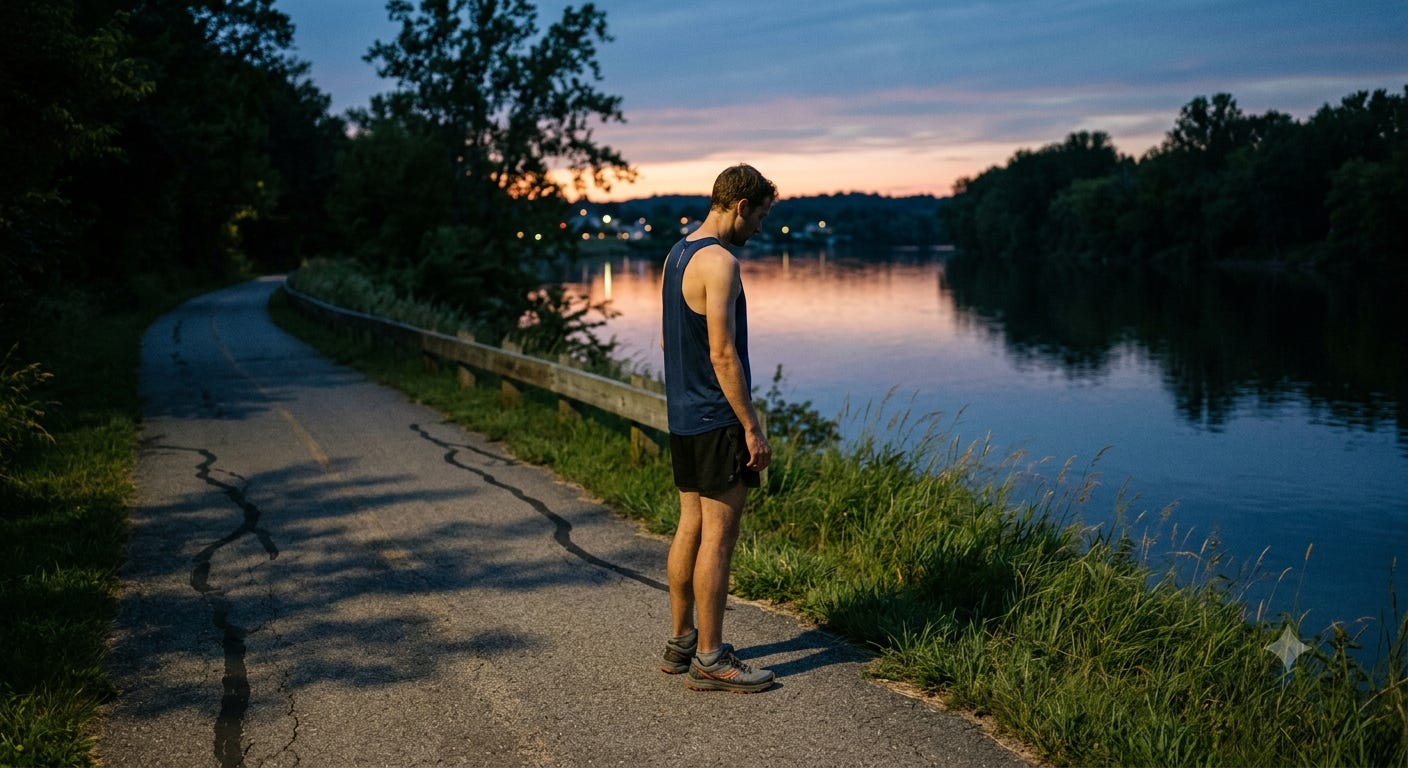
More than once since Ottawa, I’ve caught myself wondering if anything short of another 140.6 miles could give me that same spark, that same feeling again. What if nothing else feels like enough? I know that question is just the seeking part of being human showing back up, the same part that got me into this sport in the first place.
But chasing a bigger finish line every time to outrun the emptiness after the last one is a losing game, now I know this. Always, there’s a next one that has to be harder...and it will never be enough!
What to make of all this…
So here’s what I actually do with this now, and what I try to bring up with people once in a while, before talking about pacing or nutrition. Are you doing this for the right reasons? Why do you want to do it? People don’t need to wait for race week to enjoy the thing.
Somewhere around week eight of any training plan, whether it’s a 21K or a full Ironman, I start pulling my attention back onto the process itself: the Monday intervals nobody’s watching, the long ride where nothing goes wrong, showing up when race day is still four months out and nobody’s cheering for you yet, doing the boring ab-wheel once in a while...that’s where I try to put the effort and generate satisfaction.
Not on any finish line anymore...I try to think long term and about my future health first of all. How all this, is going to pay off when I’m 80 years old.
If you’re building toward something right now, a 10K, a marathon, sprint triathlon, your first 70.3, your first full, here’s the one thing I’d ask you to decide before you even start training: let the process count as much as the result. Because the race will end.
And you’ll be standing there, medal around your neck, legs still shaking, already wondering what’s next.
If you are ready to stop figuring it out alone, to own your progress with a real program and a coach who adjusts it based on your feedback, APPLY FOR COACHING or reply to this email.
Sources
1. Ben-Shahar, T. (2007). Happier: Learn the Secrets to Daily Joy and Lasting Fulfillment. McGraw-Hill.
2. Ryman Augustsson, S., Bergh, M., & Petersson, K. (2024). Post-race reactions: The emotional paradox of high performance and anxiety – a conventional content analysis. BMC Sports Science, Medicine and Rehabilitation, 16, 183. https://pmc.ncbi.nlm.nih.gov/articles/PMC11360306/